Why Swiss Glaciers Matter for Alpine Climate Study
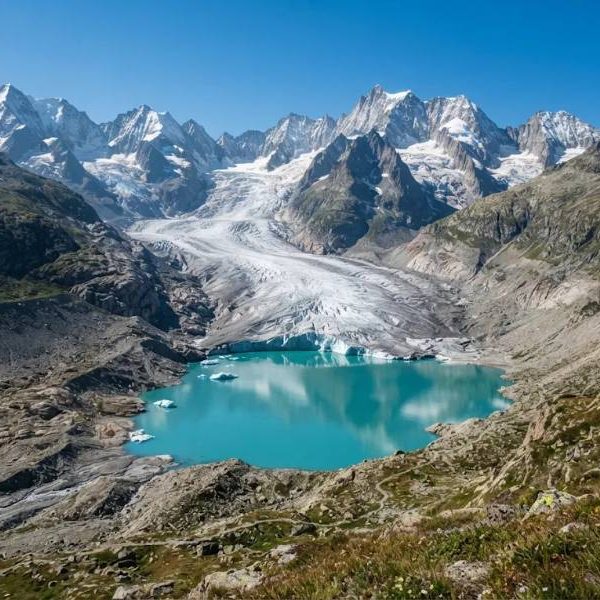
Switzerland has measured its glaciers for well over a century, which makes the Alps one of the best documented mountain regions on Earth. Every summer, teams climb to fixed points on the ice, drill stakes, weigh snow and record how much has melted. The resulting data series is a precious record of how mountain climate changes over time.
Here is what the measurements involve, what they show and why they matter far beyond the mountains.
A Long Tradition of Measurement
Swiss scientists began systematic glacier observation in the late nineteenth century. Some glaciers, such as Rhone and Gries, have records spanning generations. Long series let researchers separate natural variation from long term trends, which is not possible with only a few years of data.
International monitoring is coordinated by organisations such as the World Glacier Monitoring Service, which collects standardised observations from around the world and makes them available to researchers.
How Glaciers Are Measured
Researchers use several complementary methods. Stakes drilled into the ice show how much surface melts in a season. Snow pits and probes measure winter accumulation. Surveys of the glacier front record how far the ice has retreated. In recent decades, aerial photographs, satellites and laser scanning have added detailed maps of volume change.
Mass balance, the difference between snow gained and ice lost, is the key measure of a glacier's health. A negative balance across many years means the glacier is shrinking.
What the Records Show
Across the Alps, glaciers have lost a large share of their volume since the middle of the twentieth century, and the pace has increased in recent decades. Hot summers, low winter snowfall and dark dust or algae on the surface all speed melting. In several years, Swiss glaciers have lost a few percent of their remaining volume in a single season, an exceptional rate.
Why It Matters Beyond the Mountains
Glaciers act as natural water towers. They store winter precipitation and release it in summer, when rivers need it most. The Rhine, the Rhone, the Po and the Danube all draw part of their flow from Alpine ice. As glaciers shrink, seasonal river flows change, with consequences for hydropower, agriculture, shipping and drinking water.
Hazards in a Changing Mountain Region
Retreating ice leaves unstable slopes and new lakes. Thawing permafrost loosens rock, increasing the risk of rockfalls and debris flows. Monitoring teams track these hazards and communicate with local communities. Early warning systems, hazard maps and land use planning protect villages and infrastructure.
Tourism, Culture and Local Economies
Glaciers are part of Swiss identity and a major attraction for visitors. Ski areas, hiking routes and mountain huts depend on stable conditions. Some resorts cover small glacier areas with protective fleece in summer to slow melt, a measure that preserves ice locally but cannot change the overall trend.
Reading Swiss Research in the Original
Much of the detailed scientific literature appears in German, French and Italian, alongside English summaries. Reports from cantonal authorities, research institutes and universities often contain data and methods that never reach international journals. Accurate translation is therefore a practical research tool. Teams that need technical texts converted use German translation services to work with specialised terminology on glaciology, hydrology and hazard management.
For help understanding how scientific German is handled, read this guide to German to English translation, which addresses compound terms and long sentence structures.
Snow, Temperature and Summer Heat
Glacier health depends on both winter and summer. Heavy snowfall can protect ice by adding a reflective layer, while a hot summer strips that layer early and exposes darker ice that absorbs more heat. Saharan dust carried north by storms can also darken the snow surface, accelerating melt. Researchers track these factors with weather stations placed on and near the ice.
Energy, Water and Planning
Swiss hydropower relies on meltwater and seasonal flow. As glaciers shrink, flows peak earlier in the year and may decline later in summer, so operators and planners study new storage options. Authorities, water suppliers and farmers use glacier data to prepare for dry spells, and cities downstream follow the research closely.
Citizen Science and Education
Volunteers contribute by photographing glaciers from fixed points, recording snow depth and reporting hazards. Schools use field trips to teach students how to read the signs of change. These activities build awareness and provide extra data at low cost.
Visiting Glaciers Responsibly
Guided tours and marked viewpoints let visitors see glaciers safely. Crevasses, meltwater channels and falling ice are real dangers, so never walk onto a glacier without a certified guide and proper equipment. Check conditions with local mountain offices before you set out.
Looking Ahead
Models suggest that many smaller Alpine glaciers will largely disappear within this century, while larger ones will survive in reduced form, depending on future emissions. Monitoring will continue, because the data guide decisions on water management, energy and safety.
What Readers Can Do
Follow reliable sources, support research and monitoring organisations and reduce personal emissions where practical. When you visit the mountains, stay on marked paths, respect local rules and see the ice while it is still there.