What Is a Circular Economy? How Waste Becomes the Start of Something New
For most of the last century, the economy ran in a straight line. We dug up raw materials, made things, used them for a while and threw them away. That model, often called take, make, waste, built enormous wealth, but it also assumed the planet had endless resources and endless room for rubbish. Neither turned out to be true. This is where a circular economy comes in, and if you have ever wondered what is a circular economy in practical terms, the simplest answer is an economy designed so that materials keep circulating instead of ending up in landfill.
The idea sits close to the green economy this site follows, but it comes at the problem from a specific angle. Rather than asking how to grow more cleanly, it asks how to grow while drawing on far less new material in the first place.
What is a circular economy, in plain terms?
A circular economy rests on a few connected principles: design out waste, keep products and materials in use for as long as possible, and regenerate natural systems along the way. Instead of a bin being the final destination for a product, it becomes a pause. A phone gets repaired or refurbished. A glass bottle is washed and refilled. A worn jumper is unpicked and its fibres spun into something new.
The shift sounds simple, but it reorganises how businesses think. A company that sells a product and then forgets about it has no reason to make it last. A company that leases the same product, or takes it back at the end of its life, suddenly has every reason to build it well and recover its parts.
Circular economy examples you already know
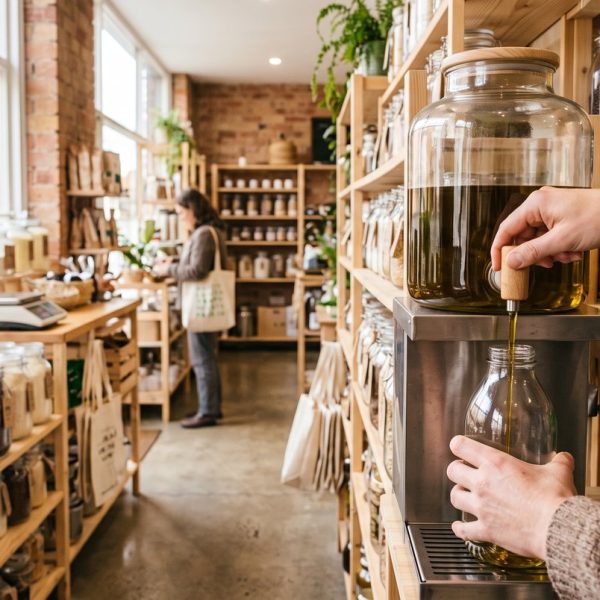
Some of the clearest circular economy examples are already woven into daily life. Refillable cleaning products cut the number of plastic bottles made at all. Deposit return schemes for cans and bottles pull materials back into the supply chain. Clothing brands that repair or resell their own garments keep textiles out of the tip. Even the humble library is circular, with one book serving hundreds of readers rather than hundreds of copies gathering dust.
Packaging is one of the busiest frontiers. Circular economy packaging tries to replace single use materials with containers that are reused, refilled or genuinely recyclable, rather than the mixed plastics that quietly end up incinerated. A great deal of the plastic that escapes these systems drifts into rivers and seas, and if you want a sobering look at where it goes, this account of how plastic gets into the ocean shows why closing the loop matters so much.
Why it matters for a green economy
The environmental case is straightforward. Making new material from scratch, whether steel, plastic or cotton, usually burns far more energy than reusing what already exists. A serious plastic circular economy, for instance, would cut the demand for new fossil based plastic and the emissions that come with it. Keeping materials in circulation also eases pressure on mines, forests and water supplies.
There is an economic case too. Repair, refurbishment and remanufacturing are labour intensive, which means they tend to create local jobs that cannot easily be shipped overseas. The wider framework has been mapped out in detail by researchers and organisations such as the Ellen MacArthur Foundation, which has spent years showing how circular models can hold their own commercially.
Circular thinking asks a simple question of any product: what happens to it after the sale, and who is responsible for that. Clothing is where the public first encountered that question, which is why so many people now ask what is sustainable fashion and get an answer that varies wildly by brand. A word without a definition is easy to borrow and hard to audit.
Circular systems work best at city scale, where waste streams and demand are close enough together to connect. Municipal policy does the heavy lifting. Several Australian cities have pushed this further than their reputation suggests, and brisbane australia is among the more active on it.
The honest obstacles
None of this happens automatically. Recycling systems are patchy and often ship mixed materials to places that cannot process them. Products are still designed to be glued shut rather than opened and repaired. And a circular label, much like a green one, can be slapped on something that has barely changed. Working out whether a product is truly circular takes real data, not marketing.
There is also a communication challenge that is easy to overlook. Circular products often carry a story about how they should be returned, refilled or repaired, and that story has to land clearly in every market a company sells to. Businesses expanding abroad soon discover that most consumers only buy in their own language, so instructions and sustainability claims need careful translation to actually change behaviour.
Where to start
For a household, the circular economy is less about grand gestures and more about small defaults: repairing before replacing, buying second hand, choosing refills, and passing on what still works. For a business, it often begins with a single product line redesigned to be taken back and reused. Neither move fixes everything, but both chip away at the take, make, waste habit.
A circular economy will not arrive fully formed, and it is not a cure for every environmental problem. But as a direction, it is a hopeful one, because it treats yesterday's waste as tomorrow's raw material rather than a burden to bury. In an economy still learning to measure what sustainable really means, that shift in thinking may prove one of the most valuable indicators of all.